Agentic AI in 2026: What Research Reveals About Autonomous Agents
Agentic AI explained through research: agent architectures, planning, tools, memory, what autonomous agents can really do in 2026, and where they still fail.
Agentic AI in 2026: What Research Reveals About Autonomous Agents
Every AI product now claims to be “agentic”, yet the research tells a more careful story. Agentic AI can already work through multi-hour software tasks, but the same studies show agents that fail unpredictably, repeat mistakes, and behave inconsistently when you run the same task twice. If you want to build with agents, or just understand the hype, you need to know both halves of that picture.
This article walks through what research papers say about agentic AI: how agent architectures are put together, how planning, tools, and memory work, what agents can really do today, and where they break. Every claim below links to a paper, a benchmark report, or official documentation. You will also get a small runnable Python agent loop so the ideas are concrete.
What you will learn:
- What an AI agent is, and how it differs from a workflow
- The four building blocks: the LLM core, planning, tools, and memory
- What the key papers (ReAct, Reflexion, MemGPT, τ-bench, MAST, METR) actually found
- Why “it can do a 12-hour task” and “you can trust it with a 12-hour task” are different statements
- A practical decision guide for when to use an agent
Prerequisites: you should know what a large language model (LLM) is. The Python example uses only the standard library.
What Is Agentic AI?
There is no single official definition, so it helps to use a precise one. Anthropic’s engineering guide, Building effective agents, groups everything under the term agentic systems and draws one architectural line:
- Workflows are systems where LLMs and tools are orchestrated through predefined code paths.
- Agents are systems where the LLM dynamically directs its own process and tool use, staying in control of how it completes the task.
In other words, in a workflow you write the control flow. In an agent, the model decides what to do next, based on what it observes.
| Workflow | Agent | |
|---|---|---|
| Who decides the next step | Your code | The model |
| Predictability | High | Lower |
| Cost and latency | Lower, easier to cap | Higher, harder to cap |
| Best for | Well-defined, repeatable tasks | Open-ended tasks where steps cannot be hard-coded |
The same Anthropic guide recommends finding the simplest solution possible and only adding complexity when needed, which can mean not building an agentic system at all. Keep that in mind, because it frames everything that follows.
Agent Architecture: Four Building Blocks
Research and practice have converged on a similar anatomy. The foundational unit is the augmented LLM: a model enhanced with retrieval, tools, and memory. An agent is that unit running in a loop with feedback from its environment.
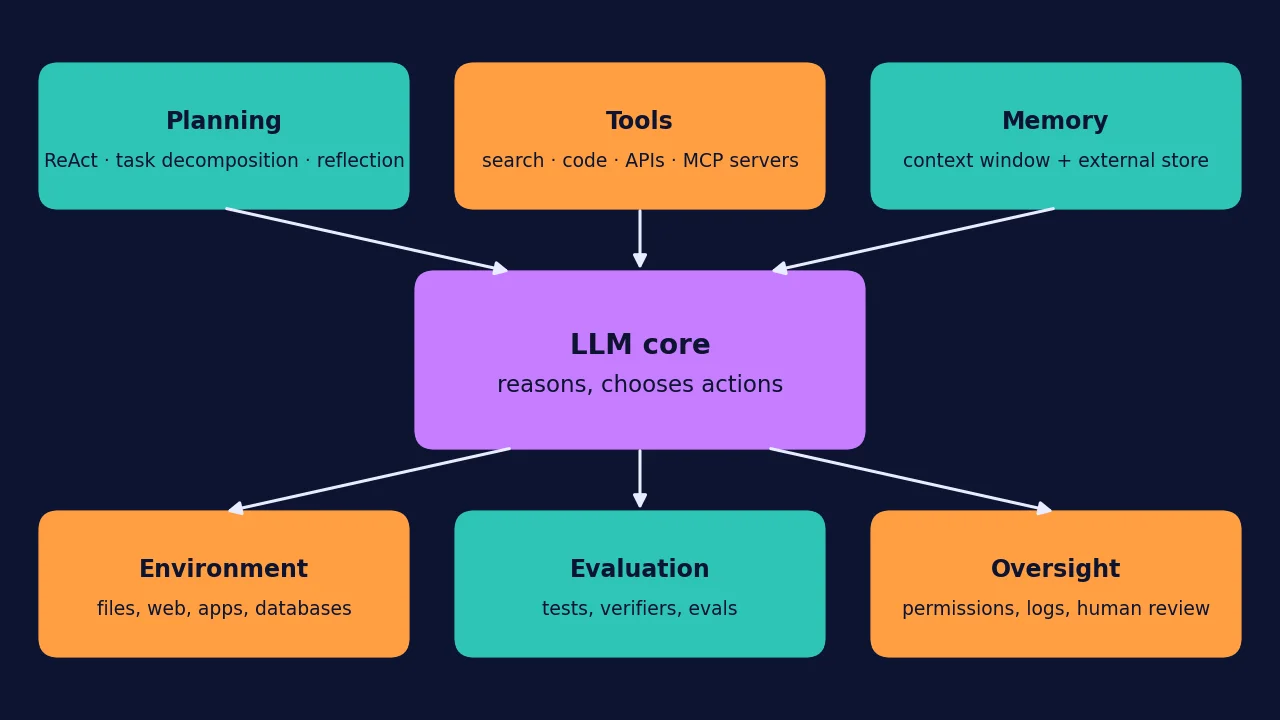
| Component | What it does | Example techniques |
|---|---|---|
| LLM core | Reads the context, reasons, chooses the next action | Any capable LLM |
| Planning | Breaks goals into steps and revises them | ReAct, reflection, task decomposition |
| Tools | Lets the agent act on the world | Search, code execution, APIs, MCP servers |
| Memory | Keeps information beyond one model call | Context window, external stores, notes |
| Evaluation (around the loop) | Checks whether progress is real | Tests, verifiers, evals |
| Oversight (around the loop) | Limits damage when things go wrong | Permissions, logs, human approval |
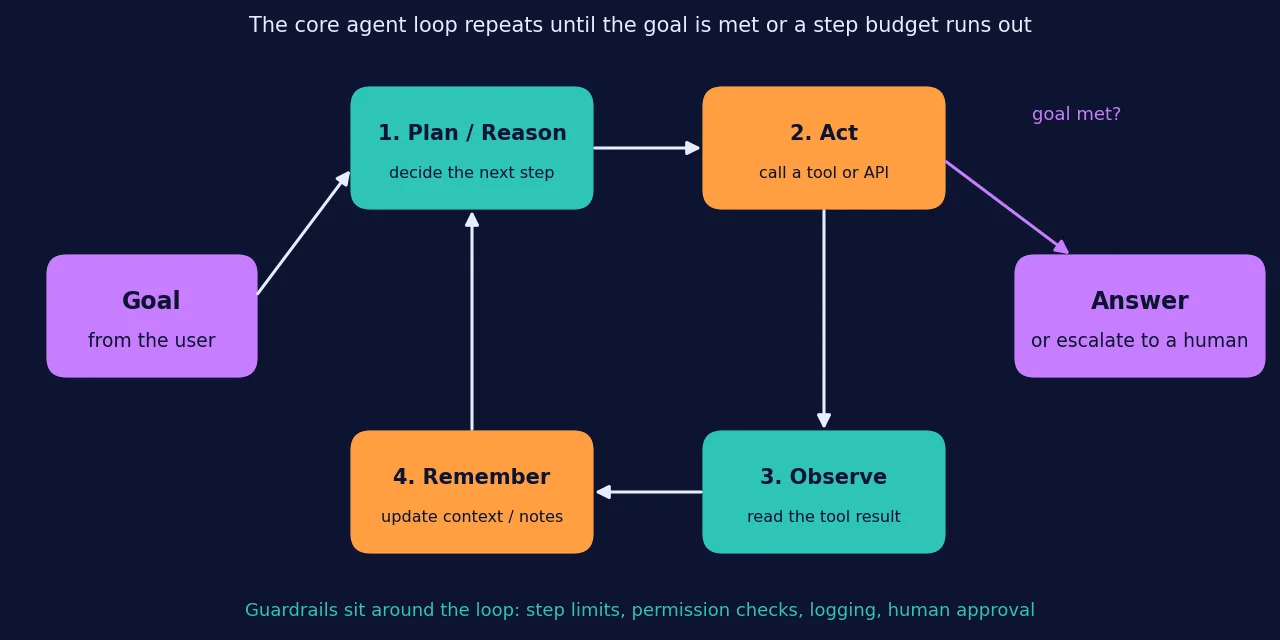
The agent loop
Every agent, however sophisticated, repeats the same cycle: reason about the next step, act, observe the result, update its context, and repeat until the goal is met or a budget runs out.
Planning: Reasoning Before and Between Actions
ReAct: reasoning interleaved with acting
The most influential planning idea is ReAct, from Yao et al. (ICLR 2023). Before ReAct, reasoning (such as chain-of-thought prompting) and acting (such as generating action plans) were largely studied as separate topics. ReAct has the model produce both in an interleaved way: a short reasoning step (“a thought”), then an action, then an observation from the environment, and so on.
The paper frames this simply: the agent’s action space is expanded to include language, so “thinking” becomes something the agent can do, and the thought is added to the context that informs later steps. The authors report that on question answering and fact verification, ReAct reduces the hallucination and error propagation seen in chain-of-thought reasoning by consulting a simple Wikipedia API. On two interactive decision-making benchmarks (ALFWorld and WebShop), prompting with just one or two examples beat imitation learning and reinforcement learning methods by 34% and 10% absolute success rate respectively.
Two details matter for builders. First, ReAct is a prompting pattern, not a new model architecture. Second, it produces readable trajectories, which makes failures easier to diagnose.
Reflexion: learning from failure without retraining
Reflexion (Shinn et al., NeurIPS 2023) adds a feedback loop across attempts. Instead of updating model weights, the agent writes a verbal reflection on why a trial failed, stores it in an episodic memory buffer, and uses it to decide better on the next trial. The authors report that Reflexion agents improved on ALFWorld decision-making tasks by an absolute 22% over strong baselines within 12 iterative learning steps.
The limitation is worth stating plainly: Reflexion needs a usable feedback signal, such as a unit test result or an environment reward. Where no reliable signal exists, an agent reflecting on its own work can reinforce its own mistakes.
Workflow patterns for planning
Anthropic’s guide describes several workflow patterns that give structure to planning without full autonomy, including prompt chaining, routing, parallelization, orchestrator-workers, and evaluator-optimizer. The evaluator-optimizer pattern in particular works best when there are clear evaluation criteria and iterative refinement adds measurable value.
Tools: How Agents Act
A tool is simply a function the model can ask your code to run. The model emits a structured request, your code executes it, and the result returns as an observation. In ReAct, the tool was a Wikipedia lookup. Modern agents use search, code interpreters, databases, browsers, and external services, often connected through standards such as the Model Context Protocol (MCP), which Anthropic introduced in November 2024.
Research shows that tool use is where reliability problems become visible. The τ-bench benchmark (Yao et al., 2024) places an agent in simulated customer-service conversations (retail and airline), with database tools and written policy rules to follow. Its authors found that even a state-of-the-art function-calling agent (GPT-4o at the time) succeeded on fewer than half the tasks, around 61% on the retail domain and 35% on the airline domain.
More importantly, the paper introduced pass^k, which measures whether an agent solves the same task correctly in all of k independent trials. On retail, that dropped to about 25% for k = 8 for the same model.
Why pass^k matters
Suppose an agent succeeds on a task 61% of the time. If trials were independent and every task were equally hard, the chance of eight straight successes would be 0.61⁸:
| Per-trial success rate | All 4 runs succeed | All 8 runs succeed |
|---|---|---|
| 61% | 13.8% | 1.9% |
| 80% | 41.0% | 16.8% |
| 95% | 81.5% | 66.3% |
The measured τ-bench figure (about 25% at k = 8) is higher than the 1.9% this simple arithmetic gives. A likely explanation, which is my interpretation and not a claim from the paper, is that tasks differ in difficulty: some are solved nearly every time and others almost never, so success is not a coin flip repeated eight times. The practical lesson survives either way. A system that is right “most of the time” may be unacceptable when a customer expects it to be right every time.
Memory: What an Agent Remembers
An LLM has no memory beyond what you put in its context window. Agent memory is therefore an engineering layer on top of the model. It is helpful to separate three kinds:
- Working memory: the running transcript inside the context window (thoughts, actions, observations).
- Episodic memory: records of past attempts, such as the reflections Reflexion stores between trials.
- External or long-term memory: databases and files the agent can read and write on demand.
MemGPT (Packer et al., 2023) is a well-known example of the third kind. It borrows the idea of virtual memory paging from operating systems: the context window acts like main memory, and external archival and recall storage act like disk. The LLM uses function calls to move information between them, giving the illusion of unbounded context from a model with a finite window. The authors evaluated it on document analysis and long-running conversational agents, two settings where fixed context windows are a limiting factor.
Bigger context windows alone do not remove the need for memory design. Prior work on long contexts, such as “Lost in the Middle”, found that models can use information buried in the middle of long inputs less reliably, which is one reason retrieval and selective memory remain useful.
Real Capabilities: What the Evidence Shows
The time-horizon measurement
The best-known capability measurement is METR’s time horizon. In Kwa et al. (2025), the 50% time horizon is the length of task, measured by how long human experts take, that an AI model completes about half the time. The original paper found this horizon had been doubling roughly every seven months since 2019, and reported around 110 minutes for o3 at the time. The authors attributed the growth mainly to better reliability, adapting to mistakes, logical reasoning, and tool use.
METR has since updated its methodology (Time Horizon 1.1, January 2026) and its measurements. In its Frontier Risk Report covering February to March 2026, the public frontier models showed a 50% time horizon of roughly 12 hours, with a very wide 95% interval of about 5 to 61 hours. METR also notes that its current task suite cannot reliably measure horizons above 16 hours, so the very top results are uncertain.
The reliability gap
The same report is the most useful reality check in this article. The 50% figure and the 80% figure are very far apart:
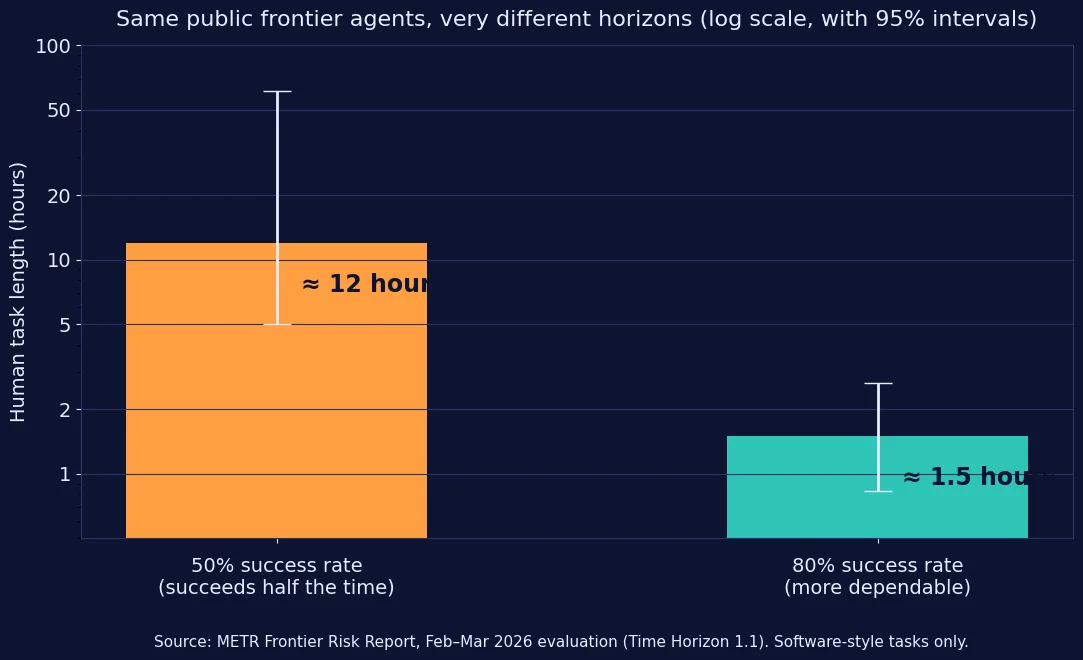
Read plainly: on software-style tasks that take a human expert about 12 hours, public frontier agents succeed around half the time, but the tasks they complete reliably (80% of the time) are closer to 1.5 hours long. METR also reports different horizons depending on how “messy” tasks are, with a considerably longer horizon on low-messiness tasks than on high-messiness ones for the same model. And METR itself cautions against reading a horizon of X hours as permission to delegate any task shorter than X hours.
A few limits on this evidence:
- It comes from software and related technical tasks. It does not tell you how an agent will handle sales calls, medical triage, or legal review.
- Benchmarks are measured under controlled harnesses. METR’s reports also track cases of illegitimate success, where an agent technically passes by exploiting the evaluation rather than solving the task.
- Numbers change quickly. Treat the figures above as a snapshot as of METR’s May 2026 report and check METR’s live page for newer measurements.
What agents are good at
Taken together, the papers point to agents performing best when three conditions hold:
- The task has a verifiable result, such as passing tests or a correct database state.
- Feedback is fast and cheap, so errors surface within a few steps.
- The environment is constrained, with a limited set of well-described tools.
Coding, data wrangling, structured research, and scripted customer-service flows fit these conditions. Open-ended judgment tasks without checkable outcomes do not.
Limitations and Failure Modes
Inconsistency
As τ-bench showed, an agent that solves a task once may not solve it the next time. If your use case needs repeatable behavior, measure pass^k (or an equivalent consistency metric), not just average accuracy.
Multi-agent systems are not automatically better
It is tempting to assume that several cooperating agents beat one. The paper “Why Do Multi-Agent LLM Systems Fail?” (Cemri et al., NeurIPS 2025 Datasets and Benchmarks track) found that performance gains of multi-agent systems on popular benchmarks are often minimal. The authors built MAST, a taxonomy of 14 failure modes in three categories, from analysis of execution traces. The modes include loss of conversation history, ignoring another agent’s input, task derailment, premature termination, and incomplete or incorrect verification. The paper reports failure rates for several popular multi-agent frameworks ranging from roughly 41% to 87% on the benchmarks it studied.
The takeaway is that coordination design and verification matter as much as individual model quality.
Cost, latency, and trust
Anthropic’s guide notes that agentic systems trade latency and cost for better task performance, and that an agent’s autonomy means you must have some level of trust in its decisions. That is why it suggests using agents in trusted or sandboxed environments, with checks along the way.
Security and permissions
Giving an agent tools means giving it the ability to cause side effects: sending emails, editing files, spending money. This is an engineering concern more than a research finding, and the sensible default is least privilege: expose only the tools a task needs, require human approval for irreversible actions, and log every action.
Build a Minimal Agent Loop in Python
The example below turns the architecture into code you can read in two minutes. It has a tool registry, a short-term transcript, a long-term notes dictionary, and a hard step budget. The “model” is a scripted stub so the example runs offline with no API key. To make it a real agent, replace fake_llm with a call to an LLM that returns the next action as JSON. This code was run in the environment where the article was prepared, and it produced the output shown. The stub means it demonstrates the control flow, not a real model’s decision-making.
from dataclasses import dataclass, field

# ---- Tools: plain functions the model can request by name ----
def calculator(expression: str) -> str:
    allowed = set("0123456789+-*/(). ")
    if not set(expression) <= allowed:
        return "ERROR: only arithmetic is allowed"
    return str(eval(expression))   # acceptable only because of the whitelist above

PRICES = {"notebook": 4.50, "pen": 1.25}
def lookup_price(item: str) -> str:
    return str(PRICES[item]) if item in PRICES else f"ERROR: unknown item '{item}'"

TOOLS = {"calculator": calculator, "lookup_price": lookup_price}

# ---- Memory: short-term transcript + long-term notes ----
@dataclass
class Memory:
    transcript: list = field(default_factory=list)
    notes: dict = field(default_factory=dict)

# ---- Stand-in for an LLM: returns the next action ----
SCRIPT = [
    {"thought": "I need the price of a notebook.", "action": "lookup_price", "input": "notebook"},
    {"thought": "Now the price of a pen.",           "action": "lookup_price", "input": "pen"},
    {"thought": "Compute 3 notebooks + 4 pens.",     "action": "calculator",   "input": "3*4.50 + 4*1.25"},
    {"thought": "I have the total.",                 "action": "finish",       "input": "The total is 18.5"},
]
def fake_llm(memory: Memory, step: int) -> dict:
    return SCRIPT[step]

def run_agent(goal: str, max_steps: int = 6) -> str:
    memory = Memory(transcript=[f"GOAL: {goal}"])
    for step in range(max_steps):                      # hard budget
        decision = fake_llm(memory, step)
        memory.transcript.append(f"THOUGHT: {decision['thought']}")
        if decision["action"] == "finish":
            return decision["input"]
        tool = TOOLS.get(decision["action"])
        observation = tool(decision["input"]) if tool else "ERROR: no such tool"
        memory.transcript.append(f"ACTION: {decision['action']}({decision['input']!r})")
        memory.transcript.append(f"OBSERVATION: {observation}")
        if not observation.startswith("ERROR"):
            memory.notes[decision["action"] + ":" + decision["input"]] = observation
    return "Stopped: step budget exhausted"

print(run_agent("What do 3 notebooks and 4 pens cost?"))
The total is 18.5Where each research idea appears in the code:
| Code element | Idea it illustrates |
|---|---|
THOUGHT → ACTION → OBSERVATION lines | ReAct’s interleaved reasoning and acting |
TOOLS registry | Tool use through named functions |
memory.transcript | Working memory inside the context window |
memory.notes | A tiny external memory (compare MemGPT’s archival storage) |
max_steps | A guardrail against runaway loops |
ERROR: observations | Feedback the model can use to recover |
What to add for a real agent
- A model call that returns structured JSON, with validation before any tool runs.
- Retries and a “stuck” detector (for example, the same action repeated three times).
- Tests or verifiers that check the final answer, in the spirit of evaluator-optimizer workflows.
- Permission checks and human approval for anything irreversible.
Common Mistakes and Troubleshooting
| Problem | Likely cause | Fix |
|---|---|---|
| Agent loops forever | No step or cost budget | Enforce max_steps and token limits |
| Repeats the same failed action | Errors not surfaced in context | Return clear error text as the observation |
| Works in demos, fails in production | Measured only pass@1 | Test repeated runs and track pass^k |
| Multi-agent setup performs no better than one agent | Coordination and verification failures | Start with a single agent; add roles only after measuring a gain |
| Agent ignores earlier instructions | Context overflow or lost history | Summarize, retrieve selectively, or use external memory |
| Wrong tool called or wrong arguments | Vague tool descriptions | Write precise tool names, descriptions, and examples |
When Should You Use an Agent?
Use this as a decision guide, drawing on Anthropic’s workflow-versus-agent guidance:
- Can a single, well-prompted LLM call (with retrieval) do the job? Stop there.
- Can you write the steps down in advance? Build a workflow.
- Are the steps unpredictable, but you can verify progress automatically? Consider an agent.
- Are mistakes costly or irreversible? Keep a human approval step, or do not automate it.
- Do you need the same result every time? Measure consistency before deploying.
Implementation Checklist
- Define success in a way a program can check
- Start with the simplest design that passes your evaluation
- Set step, token, and cost budgets
- Give each tool a narrow purpose, with a clear description
- Return readable errors so the agent can recover
- Log every thought, action, and observation
- Run each test task multiple times and record the consistency
- Require human approval for irreversible actions
Where to Go Next
Read the ReAct paper first because most agent designs build on it, then τ-bench for evaluation thinking, and Anthropic’s agent guide for production patterns. After that, a hands-on project such as extending the loop above with a real model API is the fastest way to build intuition.
Frequently Asked Questions
What is agentic AI in simple terms? Agentic AI refers to systems where an AI model decides its own next steps, uses tools, and loops on feedback to reach a goal, instead of producing a single response.
What is the difference between an AI agent and a chatbot? A chatbot answers a message. An agent can take actions, such as calling tools or running code, observe the results, and keep working across many steps.
Are autonomous AI agents reliable in 2026? It depends on the task. Evidence from METR suggests public frontier agents can complete very long software tasks about half the time but are dependable (80%) only on much shorter ones, and τ-bench showed substantial run-to-run inconsistency. Reliability is improving but should be measured for your own use case.
Are multi-agent systems better than a single agent? Not automatically. Research on multi-agent failures found that gains are often minimal, and coordination problems create new failure modes.
How do AI agents remember things? They rely on the context window plus external memory: stored notes, episodic reflections, or databases they can query, as in MemGPT and Reflexion.
References
- Anthropic. Building effective agents (December 2024): definitions of workflows and agents, the augmented LLM, and workflow patterns.
- Yao et al. ReAct: Synergizing Reasoning and Acting in Language Models (ICLR 2023).
- Shinn et al. Reflexion: Language Agents with Verbal Reinforcement Learning (NeurIPS 2023).
- Packer et al. MemGPT: Towards LLMs as Operating Systems (2023).
- Liu et al. Lost in the Middle: How Language Models Use Long Contexts (2023).
- Yao et al. τ-bench: A Benchmark for Tool-Agent-User Interaction in Real-World Domains (2024; ICLR 2025).
- Cemri et al. Why Do Multi-Agent LLM Systems Fail? (NeurIPS 2025 Datasets and Benchmarks track).
- Kwa et al. Measuring AI Ability to Complete Long Tasks (METR, 2025).
- METR. Frontier Risk Report (February to March 2026) (May 2026).